
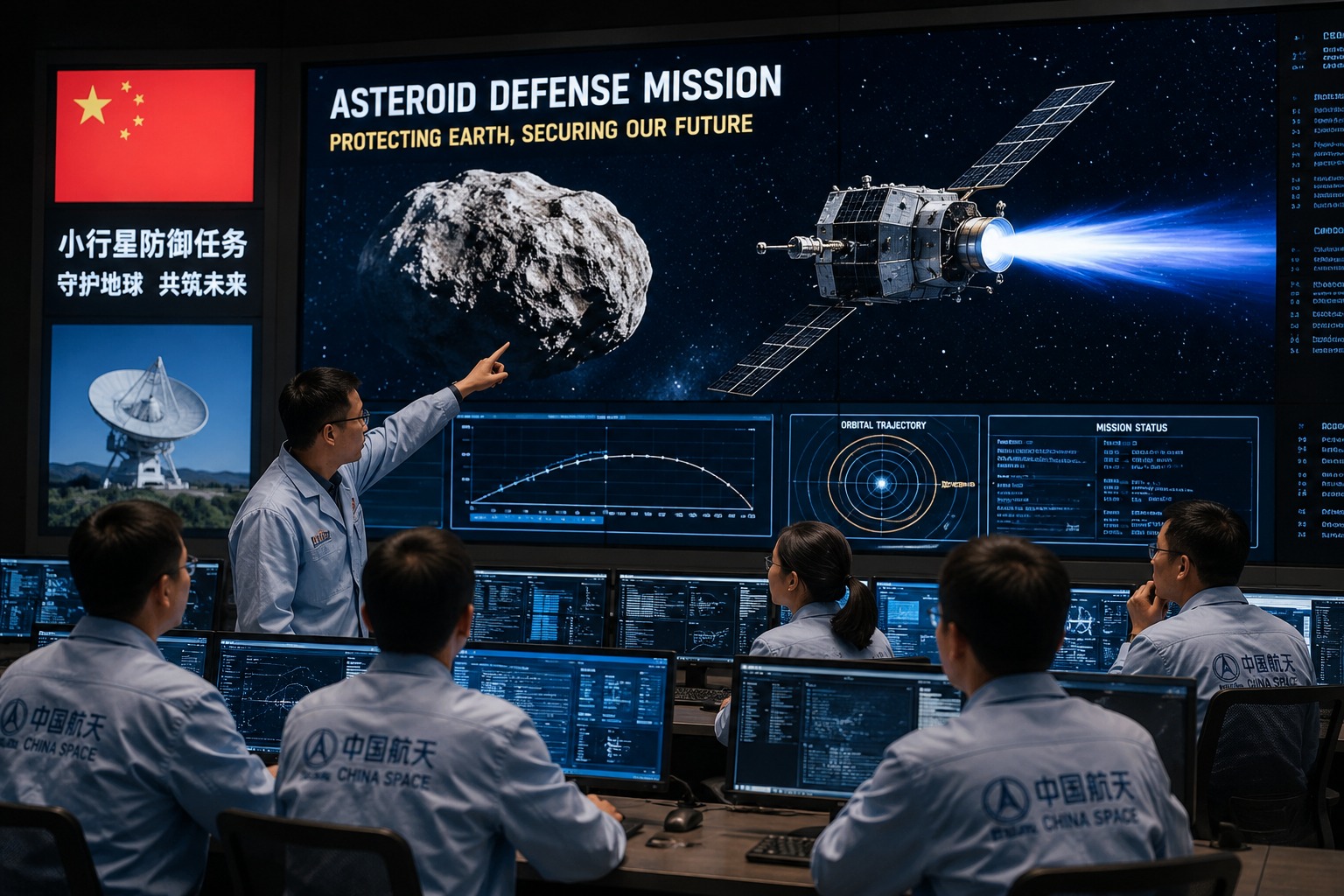
China's Asteroid Defense Mission: Preparing to Crash a Spacecraft into an Asteroid Before 2030
Introduction
The possibility of a large asteroid striking Earth has fascinated scientists and the public for decades. While such events are extremely rare, history has shown that even relatively small space rocks can cause significant damage if they enter Earth's atmosphere. To prepare for this low-probability but high-impact threat, space agencies around the world are investing in planetary defense technologies.
China has now announced an ambitious step in this direction. The country is preparing a planetary defense mission that aims to deliberately crash a spacecraft into an asteroid before 2030. Unlike a simple scientific experiment, the mission is designed to test whether a fast-moving spacecraft can alter an asteroid's orbit or, if necessary, affect its structure to reduce the potential risk to Earth.
This mission represents another major milestone in China's rapidly growing space program and reflects a broader international effort to develop practical methods for protecting Earth from potentially hazardous asteroids.
China's New Planetary Defense Strategy
China's latest mission focuses on one of the most practical planetary defense techniques currently available: the kinetic impact method. Instead of using explosives or other complex technologies, the idea is relatively straightforward.
A specially designed spacecraft will travel through space and intentionally collide with a selected asteroid at extremely high speed. According to Chinese researchers, the spacecraft is expected to strike the asteroid at a velocity of more than 9 kilometers per second, generating enough momentum to slightly change the asteroid's path.
Although the orbital change may appear tiny, even a small adjustment made years before a potential Earth encounter could cause the asteroid to safely miss our planet.
The mission is expected to take place before 2030, making it one of China's most significant contributions to planetary defense research.
Why Scientists Want to Change an Asteroid's Orbit
At first glance, changing the orbit of an asteroid may sound impossible. However, space operates differently from Earth.
Objects in space travel predictable paths governed by gravity. If scientists can change an asteroid's speed by even a fraction of a meter per second while it is still millions of kilometers away, the small difference gradually grows over time.
Years later, that tiny change can become thousands of kilometers, allowing the asteroid to pass safely by Earth instead of colliding with it.
This is why experts emphasize early detection. The sooner a potentially hazardous asteroid is discovered, the easier it becomes to redirect it using relatively modest technology.
How the Kinetic Impact Method Works
The kinetic impact technique relies on the simple physics of momentum.
Instead of destroying the asteroid, a spacecraft acts like a high-speed projectile. When it collides with the asteroid, it transfers part of its momentum to the space rock.
The impact can:
- Slightly reduce or increase the asteroid's speed.
- Shift its orbital trajectory.
- Potentially eject debris that provides additional momentum, making the deflection even more effective.
Scientists carefully calculate the spacecraft's mass, impact angle, and collision speed to maximize the deflection while minimizing uncertainty.
The method is considered one of the safest and most realistic planetary defense options because it avoids the unpredictable effects that nuclear explosions could create in space.
More Than Just an Experiment
Chinese scientists have indicated that this mission is not solely about demonstrating technology.
Researchers also want to better understand:
- The internal composition of asteroids.
- Surface materials and rock strength.
- How different asteroid types respond to high-speed impacts.
- Whether changing an asteroid's structure could help reduce future risks.
Asteroids vary greatly in composition. Some are solid rock, while others resemble loose collections of rubble held together by gravity. These differences significantly affect how an asteroid reacts during a collision.
Gathering real-world data will help improve computer models and make future planetary defense missions more accurate.
Learning from NASA's DART Mission
China's mission follows the success of NASA's Double Asteroid Redirection Test (DART), which made history in 2022.
The DART spacecraft intentionally collided with the asteroid moonlet Dimorphos, successfully changing its orbit around the larger asteroid Didymos.
The mission proved for the first time that humanity can intentionally alter the motion of a celestial object in space.
China's upcoming mission builds upon this concept but aims to expand scientific understanding through different mission designs, impact conditions, and asteroid targets.
Rather than competing, these missions collectively strengthen humanity's ability to respond to future asteroid threats.
Why Planetary Defense Matters
Hollywood movies often portray asteroid impacts as dramatic disasters, but planetary defense is based on careful scientific planning rather than panic.
Earth experiences thousands of small meteoroid impacts every year. Most burn up harmlessly in the atmosphere.
However, larger asteroids can pose genuine risks.
Scientists estimate that:
- Small asteroids can damage local regions.
- Medium-sized asteroids could destroy entire cities.
- Extremely large asteroids could have global environmental consequences.
Fortunately, astronomers continuously monitor the sky using powerful telescopes that identify and track near-Earth objects.
The challenge is not simply finding these objects but developing reliable methods to prevent future collisions if one is ever found on a dangerous path.
The Importance of Early Detection
No planetary defense mission can succeed without discovering hazardous asteroids well in advance.
Space agencies worldwide operate extensive observation networks that search for previously unknown near-Earth objects every night.
Once an asteroid is discovered, astronomers calculate its orbit using repeated observations.
If there is even a slight chance that it could threaten Earth decades into the future, scientists begin continuous monitoring to improve prediction accuracy.
Early warning provides valuable time.
Instead of attempting a desperate last-minute intervention, engineers can carefully plan a mission that gently alters the asteroid's orbit years before any possible impact.
This approach greatly increases the chances of success while reducing mission complexity.
Challenges Facing China's Mission
Although the concept appears simple, executing such a mission involves enormous technical challenges.
The spacecraft must navigate millions of kilometers through space with extraordinary precision.
Unlike landing on a planet, an asteroid is relatively tiny and constantly moving at high speed around the Sun.
Engineers must ensure the spacecraft arrives at exactly the right location and strikes the asteroid at the planned angle.
Scientists also need accurate information about the asteroid's:
- Rotation speed
- Shape
- Density
- Surface composition
- Internal structure
Unexpected characteristics could influence the effectiveness of the collision.
Advanced guidance systems, autonomous navigation, and sophisticated imaging technologies will all play crucial roles in mission success.
International Cooperation in Planetary Defense
Protecting Earth from asteroid impacts is not a challenge that belongs to one nation.
A dangerous asteroid would threaten every country, making international collaboration essential.
Scientists from multiple space agencies already share observation data, orbital calculations, and research findings through global planetary defense organizations.
China's mission adds another valuable source of scientific knowledge that could benefit future international efforts.
As more countries develop asteroid deflection technologies, humanity's overall preparedness continues to improve.
Rather than duplicating efforts, these missions provide complementary data that strengthens global defense capabilities.
What This Means for the Future of Space Exploration
China's asteroid mission highlights how space exploration is evolving beyond scientific discovery alone.
Future space missions are increasingly expected to serve practical purposes, including:
- Planetary defense
- Resource exploration
- Space infrastructure development
- Deep-space navigation technologies
- Advanced autonomous spacecraft operations
Technologies developed for asteroid missions may later support asteroid mining, deep-space transportation, and human exploration beyond Earth's orbit.
In this way, planetary defense research contributes not only to Earth's safety but also to the broader future of space exploration.
Could Humanity One Day Prevent an Asteroid Disaster?
The encouraging answer is yes—at least for many known asteroid threats.
Scientists no longer view asteroid deflection as science fiction. Successful demonstrations have shown that carefully planned missions can change the trajectory of space objects.
However, success depends on preparation.
Unknown asteroids discovered only shortly before impact would leave far fewer options.
This is why investments in sky surveys, improved telescopes, planetary defense research, and international cooperation remain essential.
China's planned kinetic impact mission represents another important step toward ensuring that humanity possesses the tools needed to respond if a dangerous asteroid is ever found on a collision course with Earth.
Conclusion
China's plan to intentionally crash a spacecraft into an asteroid before 2030 demonstrates how planetary defense is becoming an increasingly important part of modern space exploration. By testing whether a high-speed impact can alter an asteroid's orbit or affect its structure, Chinese scientists hope to improve humanity's ability to protect Earth from future cosmic threats.
The mission builds upon earlier international achievements while contributing valuable new scientific data about asteroid behavior, spacecraft navigation, and impact physics. Although the likelihood of a major asteroid impact remains low, preparing today offers the best chance of preventing tomorrow's disaster.
As nations continue to invest in planetary defense technologies, the world moves closer to a future where humanity is not merely observing space but actively safeguarding our planet from one of nature's most unpredictable hazards.